
It was truthfully my honor to be able to interview my biggest and long-time inspiration, fantasy and sci-fi illustrator, Rodney Matthews. I have followed his work since I was a very young child, which stimulated my dreams of becoming a professional illustrator. Rodney’s dedicated work ethic and imaginative ideas are more than evident in his creations but also in his intuitive responses in our interview. He tells me tales of his inspirations, details on how he sets about creating his artwork, amusing memories and experiences, and why he decided to go freelance…
What does the world of fantasy and fantasy art mean to you?
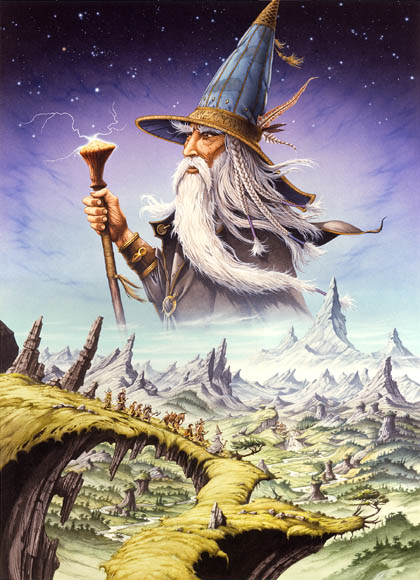
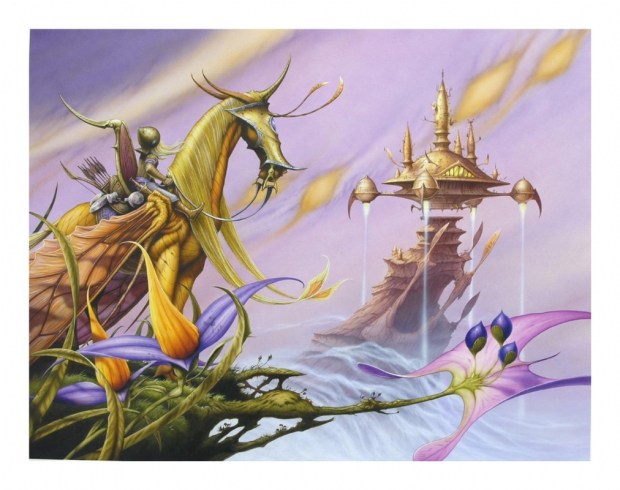
I have always lived and breathed fantasy, even as a child. I always warmed towards films that took me into fantasy worlds rather than real ones. I seem to have been programmed to invent unusual and timeless landscapes, bizarre creatures and alien beings. For fifty years it has been my living.
Describe a typical working day for you?
As a Christian I start the day with a prayer and then work on to a bowl of porridge with fruit or, if I am really fortunate, my wife Sarah makes me a cheese and tomato omelette. I wander into my studio and, browsing my diary, I decide if there is anything I have to do that is more important than starting work: discussions with the VAT man, tax considerations, ringing the the plumber, etc. – you know the sort of thing. If the coast is clear I set about my artwork. This could be anything from a rough initial pencil sketch to the final airbrush pass on an almost finished colour artwork. This continues for most of the day, punctuated by several cups of tea, until finally I arm myself with a glass of wine and slouch in a chair.
What does your artistic process involve; the stages of developing from your imagined ideas into a finished artwork?
It starts with loads of thought and the elimination of ideas that do not work. I will spend hours roughing out layouts on a tracing pad before I come to the point of decision on an idea that does work. If I am working to a commission I have to satisfy the requirements of my customer, this is where conflict can set in, as I struggle to make a sometimes bad suggestion into an agreeable image. Rough sketches can take several days, then onto a finished pencil drawing and then the full colour artwork, which is completed larger than the intended reproduction size.
What was your defining moment of breaking into the industry?
Breaking into the fantasy art arena can be extremely difficult and sometimes feels like a labour of love. My big break was when I managed to get some photographs of my artwork in front of Peter Ledeboer, the founder of the now legendary Big O poster company. He fell for my stuff immediately and proceeded to commision poster art, which was required as fast as I could produce it. This relationship lasted as long as the seventies fantasy boom and was aided and abetted by Michael Moorcock, who recommended me to all his publishers.
Why did you decide to go freelance?
Previous to 1970 I had worked in an advertising agency in Bristol, where I was required to work in several disciplines. My title was an illustrator, but I also found myself involved with copywriting, discussions with clients and drawing uncomplimentary caricatures of the management! I learnt also to work from 8am to 6pm with a lunch break, instead of sitting around waiting for eureka moments. Eventually, I became bored and decided to go for freedom and risk instead of a steady job.
What makes a fantasy artists’ work stand out?
In advertising my job was to sell products, to hit people between the eyes in a visual sense, causing them to part with their money. Commercial fantasy is much the same thing, by means of my layout, my subject matter, my colour schemes and hopefully originality, I have to convince them that they want to buy my work.
How did you perfect your artistic skills to create your fantasy masterpieces, and are there any resources that particularly helped you to master techniques?
In the beginning I put in many hours of unpaid work, because I was obsessed with creating unusual imagery. Getting paid for such work is another skill that one has to work on. My chief resources would have been observation and taking camera shots of wildlife and landscapes, which I would then convert to fantasy scenes. I have found that the best fantasy should contain elements of reality, thus giving the viewer a foundation in something that they know and understand, before lifting them into realms of “impossibility”.
What do you do to take a break? Any hobbies?
I do like to walk in the countryside with my wife, but regarding hobbies I am currently working on an album of music related to my imagery with some friends. If all goes according to plan, the music may turn out to be a little more than a hobby.
Any funny/memorable stories concerning previous clients/projects?
There are many, but the first one that comes to mind refers to the aforementioned Peter Ledeboer, who once substituted my three monthly royalty payment with a Lotus Elan +2 sports car in white!
Are there any skills you wish you had that are not art related? Why?
I wish I could spell. It would save a lot of time.
If you had the opportunity, which world/scene in an artwork that you have created would you most like to live in/be a part of and why?
I’ll stick with planet Earth for the moment, but if I were forced to make a choice, then it would be my Alice in Wonderland world (bizarre, but not too frightening).
(One artwork from this series seen below)

Are you currently working on anything? Can you give a sneak peak/insight?
I am currently working on a pair of retro themed and fantasy orientated albums of music by The Rolling Stones. These are not studio albums, but collections of recordings from the band’s heyday in the mid 60s. This project was commissioned by someone who had previously used my Stones ‘Another Time, Another Place’ on a retro album cover.
To find out more about Rodney’s exceptional work please visit:
 Blog
Blog 