

New York based Canadian artist Tristram Lansdowne works in painting, installation and print, his artistic focus is on themes relating to the histories of landscape and architecture, particularly utopian trends and modernist architecture. In response to my questions he notes the theories behind his work, the artistic processes he undertakes for his creations, and his thoughts on fantasy art.
What does the world of fantasy and fantasy art mean to you?
Truth be told, I’m not really involved in fantasy art. I’m certainly interested in the origins of fantasy art, or where it gets a lot of inspiration – Romantic, Symbolist and Pre-Raphaelite painting, science fiction, Modernist architecture, Utopian design etc. but I’m very uncomfortable with the word fantasy and what it means for art making. The lure of all those genres is their insularity, their desire for a static system, for the world to stay as it is, or as it once was; that’s what makes them so seductive, but also very ideologically counterproductive. It’s hard to describe – I am captivated at the same time as I am repulsed by the implications of such world views.
Describe a typical working day for you?
I like to start early, and if I am working on a painting I get right to it. I like to be in studio for 8-12 hours, but as the day goes on I paint less and focus on other things more. I prefer to handle all the other things – emails etc., in the evening.
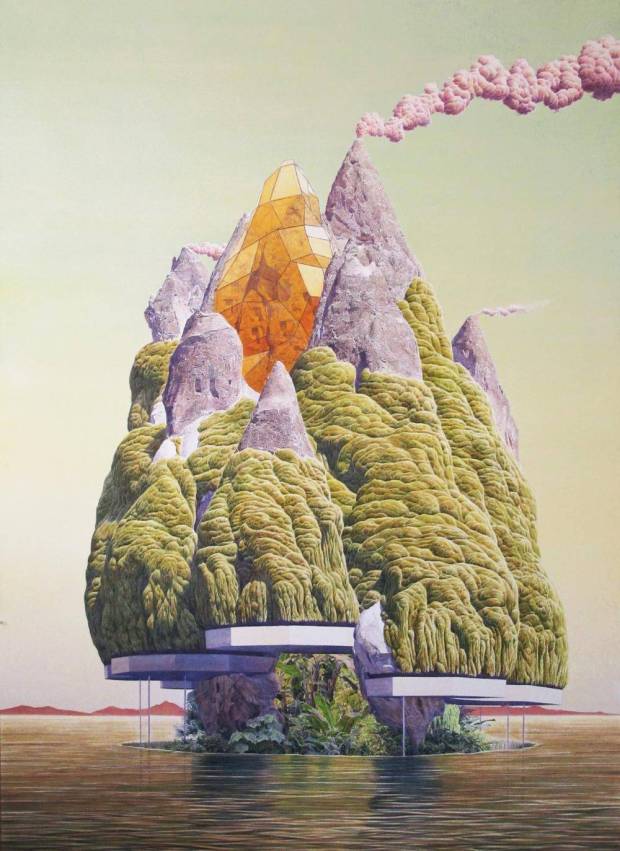
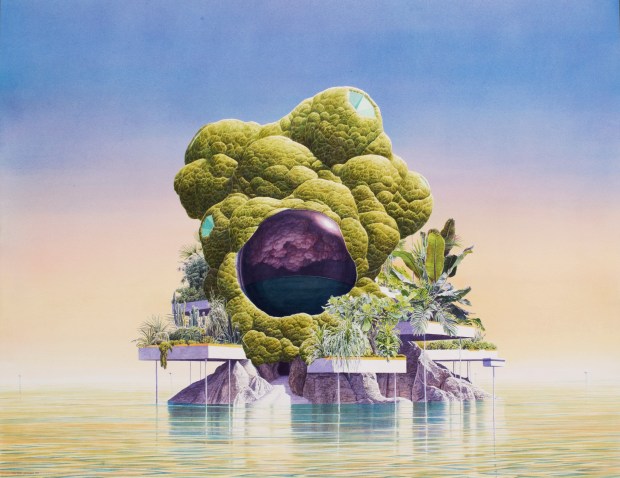
Your range of architectural/botanical island paintings are very surreal, any hidden meanings?
No, I’m pretty straight up with how I think about their meanings. I guess there were two impulses – the first was to take things very literally from the different histories I was studying – architectural, art historical, botanical, etc., so that their references were clear to anyone who also studies those things, because a lot of the paintings’ content resides in those histories. The other impulse is that i want someone who knows nothing about those histories, or my work, and be able to understand a lot just from looking at the painting. I like the work to be self-evident no matter how knowledgeable the viewer is, if that makes sense. Communicating in art is hard enough without hiding meanings in there too.
What does your artistic process involve; the stages of developing from your imagined ideas into a finished artwork?
It depends on the work, but for paintings I don’t do much prep work. I make tiny scribbly drawings in my book, and that helps me see what I want to make, and then I just start pencilling out the image on the watercolour sheet. I find that much more prep work kills the idea for me, and I lose interest.
What was your defining moment of breaking into the industry?
I don’t know, this industry is so capricious in it’s attentions. I guess the most exciting moment was when the National Gallery of Canada bought a couple of my paintings. I was pretty proud of that.
What makes a fantasy artists’ work stand out?
A sense of unease maybe, or a sense that the artist is searching for something.
How did you perfect your artistic skills to create your final artworks, and are there any resources that particularly helped you to master techniques?
Technique-wise, I just practiced. My father was a painter, and there was a brief period after my undergrad degree where he gave me good technical critiques, but otherwise you just have to practice and rely on your friends for constructive feedback.
What do you do to take a break? Any hobbies?
Not really/. Most of my spare time is spent in studio. I do like getting out into the woods now and then. I grew up camping and hiking a lot, and now that I live in a bigger city I miss it.
Are there any skills you wish you had that are not art related? Why?
Sure, lots! I wish I were better at languages. I wish I knew how to sail. There seems to be a lot of freedom to both of those skills.
If you had the opportunity, which world/scene in an artwork that you have created would you most like to live in/be a part of and why?
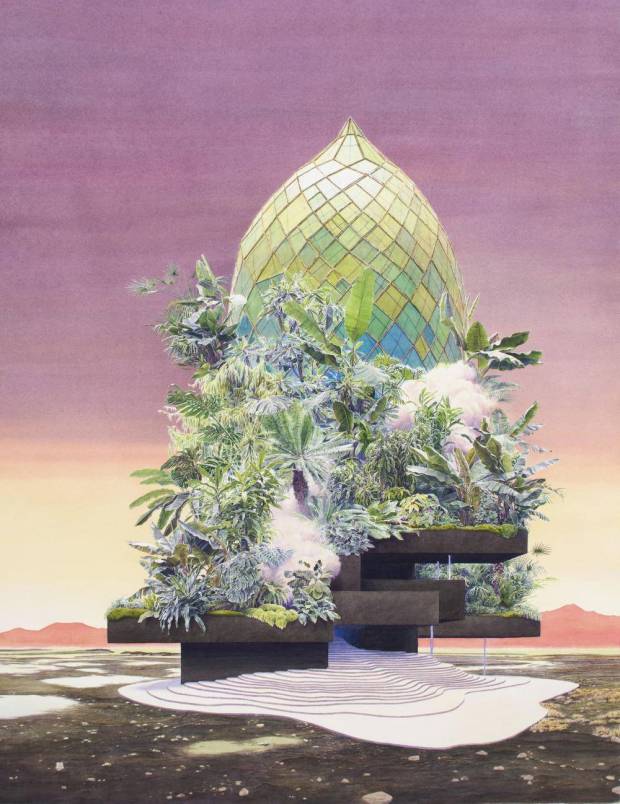
That’s tough to answer because I was trying to make worlds that were flawed. I’m making paintings of luxury homes now that would be interesting to see in three dimensions. I wouldn’t want to live in them, but to experience them would be great. Maybe I would live in a building I painted called The Destroyer, which has a multicoloured glass dome taken from Bruno Taut’s Glass Pavilion. (Seen below)
Are you currently working on anything? Can you give a sneak peak/insight?
I’m working on several projects, the most developed one being the luxury homes I just mentioned. I’m also working on a series of works based on New York City I by Mondrian.
To find out more about Tristram’s work please visit:
 Blog
Blog 