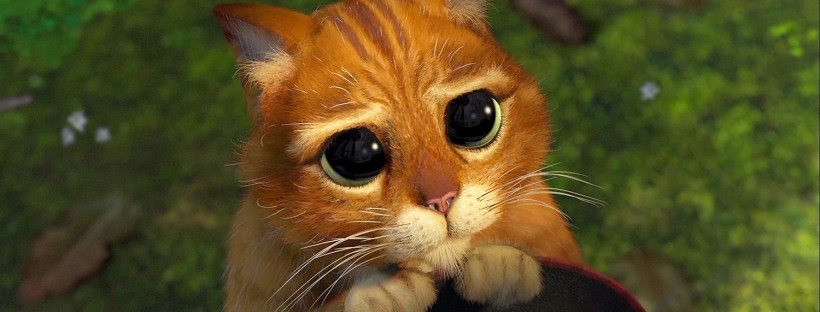
A truly creative character can be said of American Art Director, Matte Painter, Animator and Instructor, Jeff Bedrick. His direct, focused approach to answering my questions is no doubt a reflection of his strong work ethic and passion to create. One of his most prominent contemporary works is his matte painting contribution to the DreamWorks animated film, “Shrek 2”. Jeff highlights the contrast between his love of painting and love for filmmaking, and touches on some crucial points to consider for anyone hoping to break into the industry…
What does the world of fantasy and fantasy art mean to you?
I began my career as an apprentice to an older, established artist named Gage Taylor. He was a prominent member of an art movement popular in the 1970s and 80s called the California Visionaries. This genre grew out of the psychedelic movement of the 1960s and even had roots in the earlier surrealist movement of the early 20th century. I had always been interested in this kind of art since childhood and then had the incredible opportunity to learn from them. Visionary art in that context was more of a fine art movement in which the Utopian imagery was an expression of deeply personal principles and ideals. Therefore, it wasn’t strictly considered “fantasy art” which I think of as a more commercial kind of escapist fantasy illustration. Specifically, while more mainstream fantasy artists might create entertaining illustrations of godly warriors, magical princesses, and mythical creatures, I was more interested in slightly more serious concepts like metaphors for consciousness and the human condition.
Eventually, I noticed a significant rift between my views and that of the galleries and publishers representing me. Even many of my fans and collectors seemed to espouse an almost cult-like ideology that I did not share. So, with a body of work that I was proud of having created, I was ready to move on to a new phase of my career. I drifted toward commercial illustration out of the necessity to make a living. Ironically, this occasionally included fantasy illustration assignments from clients who weren’t particularly interested in my past or my philosophy. In this new context, creating fantasy art as a simple form of escapist entertainment was enjoyable without concerns about it being misinterpreted.
I understand and appreciate the popularity of this genre. The success of franchises like Lord of the Rings, and Harry Potter are testaments to that. There are many amazing artists working in the fantasy genre these days and I admire their talents.
What inspired the decision to shift your career onto animation and visual effects?
I was always interested in filmmaking and animation as well as in painting. However, when my career started before the digital age, film was a prohibitively expensive hobby and the film industry wasn’t very welcoming to newcomers like it is today. So, I stuck with painting. However, I did have the opportunity to work part time as an art and animation assistant at a small San Francisco animation studio called Colossal Pictures. There, I got a great education about the animation process, as well as some great connections with colleagues who also worked there.
Fast forward many years. The digital age arrived, and I taught myself to use Photoshop. Suddenly, I could produce a much higher volume of work in a fraction of the time, without sacrificing quality. New opportunities in the film and game industries opened. Eventually, I landed a position as a digital matte painter at DreamWorks where I created many of the background for Shrek 2. Since then, animation and visual effects became yet another facet in my career, mostly with freelance projects.
Describe a typical working day for you?
I honestly don’t have a “typical” working day. Every day is different. I teach part time at the San Francisco Academy of Art University. Days and hours vary each semester depending on enrollment. Other projects come and go, rather unpredictably. In the last couple of years, I have illustrated several sets of fortune-telling cards for a large publisher, worked on photo-retouching for a major virtual reality project, created an illustration for the Orlando Public Utilities Commission, directed and edited some live action and animated music videos, and produced a series of detailed design plans for a luxury real estate contractor.
Your career so far has seen a large variety of artistic roles, which have been the best and why?
It’s hard to choose the best. Each project and position has value in different ways. My early career as a traditional painter was a great foundation for all the different kind of work that was to come later. The most exciting kind of work is probably directing live action but that is also the most logistically demanding.
What was your defining moment of breaking into the film industry?
I’ll let you know whenever that happens. But seriously, I think that people who are even more established in the film industry than me would say that. You’re only as good as the last thing you’ve done, and people have short memories. Having said that, my first entry level job as an art assistant at Colossal Pictures, was my first entry into that world. My job as a matte painter at DreamWorks was probably my most commercially notable experience. I was recently credited as Art and Animation Supervisor on London-based director James Hughes’ short film, The Velvet Abstract, now making the film festival circuit. Even with all that, I’m uncertain what may come next.
What portfolio advice would you give to a budding illustrator wanting to join the film industry?
Remove half the pieces that you want to put into your portfolio. When you’ve done that, remove half again. That’s true for any portfolio. As to “breaking in” to the film industry, my advice is not to wait for an invitation. Just start making short films. Experiment. Be inventive and resourceful.
Having said that, there are jobs for artists in the film industry. Storyboard artists and concept illustrators are the most basic. From there, more technical skills are required such as 3D modelling and animation, compositing, color grading, lighting and texture, etc.
How did you perfect your artistic/creative skills, and are there any resources that particularly helped you to master techniques?
Nice of you to say but no one ever “perfects” their skills, especially not me. I am constantly humbled by the creative skills of other artists whose work I could never match. However, I had a passion and drive to create and to always improve. There are all the familiar artistic principles like anatomy, perspective, color, etc. that are essential for artists to learn. It is also important to have a strong knowledge of art history. It may sound harsh, but artistic talent isn’t really something that can be taught. Some people just have a natural gift and drive to create. It may not seem fair, but it’s not for everyone.
What do you do to take a break? Any hobbies?
I honestly don’t make much categorical distinction between work and recreation. I spend a lot of time with my beautiful daughter who will probably surpass me artistically someday. We enjoy movies and exploring outdoors when the weather is nice. One of my best friends is a commercially successful musician with whom I often collaborate on assorted projects.
Any funny/memorable stories concerning previous clients/projects?
There are so many memorable projects but nothing that I’d describe as funny coming to mind. However, following is an interesting excerpt from my instructor showcase segment from an illustration class that I teach.
This is a collaboration between me and another illustrator named Laurel Long for a children’s book called The Legend of Holly Claus. Laurel had already done some beautiful pen & ink illustrations for the novel version. The publisher then wanted to adapt the novel as a shorter illustrated children’s book. However, working only in traditional materials, she was unable to do all the full color work in the time available. The author was a friend who asked me to help. I did a sample of a full color digital illustration based on one of Laurel’s pieces to show the publisher what was possible.
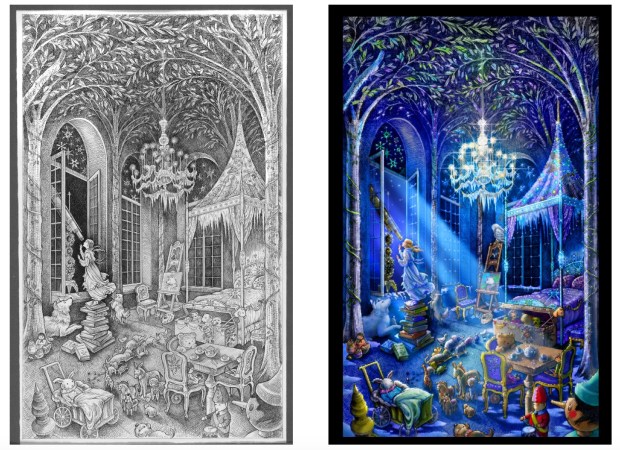
Holly’s Room, pen & ink sketch, Laurel Long (Left).
Holly’s Room, Laurel Long and Jeff Bedrick (Right).
The publisher was excited when they saw how quickly I was able to convert the pen & ink illustrations into full color. I then was hired to do all the color illustrations for the children’s book.
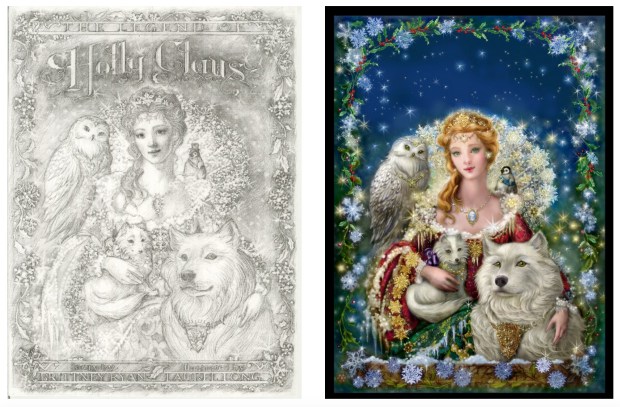
The Legend of Holly Claus pencil sketch, Laurel Long (Left).
The Legend of Holly Claus cover art, Laurel Long and Jeff Bedrick (Right).
Laurel did this lovely rough pencil sketch for the cover art, which I then finished in color. The publisher’s graphic design department added the title later.
Also included is one of the many other finished interior illustrations. This one depicts an enchanted workshop:
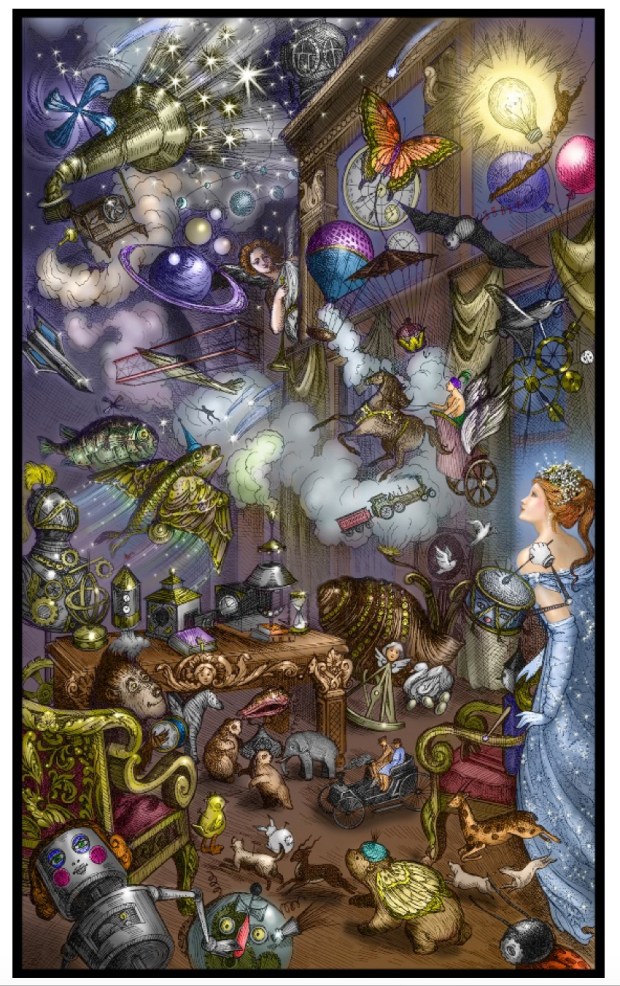
After years of collaborating with large teams of artists in animation and game studios, I was well-accustomed to the process, yet this situation was different: I knew that the other artist had reservations about anyone else altering her work. However, it was the only way to get the job done. So, I tried to be as respectful as I could by preserving her beautiful line work and general style to the best of my ability.
This is a perfect example of how digital art can step in where traditional art leaves off. The convenience and speed of doing this project digitally was the difference between a major publisher saying yes or no.
If you had the opportunity, which world/scene in an artwork/film that you have created would you most like to live in/be a part of and why?
When I was much younger, I used to sometimes imagine being able to escape into my idyllic creations, with no single piece really coming to mind. This was during a period when the drug culture was prominent and it seemed that everyone was looking for some form of escape from reality. However, I soon began to regard this impulse as rather cowardly and ineffective. I therefore made a conscious choice to embrace the richness of real life, with my life as an artist being an enjoyable part of that life.
What are your favourite aspects of digital matte painting?
Digital matte painting is a specialized form of illustration that is composited into cinematic shots, often with live action or animated elements. As an artist who has always been interested in filmmaking, I gravitated to matte painting because it is a great crossover between these two art forms. It is also a chance to breathe some life into your work by creating matte paintings in multiple depth layers that allow for camera moves and other animated effects.
Are you currently working on anything? Can you give a sneak peek/insight?
I recently directed and edited this short, fun music video for my friend Raj Ramayya’s recent re-release of his Pokemon theme song:
I have also recently completed a couple of fully animated music videos but they have not yet been released to the public.
Other than that, I’m on a bit of a break at the moment and looking forward to whatever comes next.
To find out more about Jeff and his many artistic talents visit:
 Blog
Blog 