
It was a true delight to be in conversation with fantasy and sci-fi illustrator, John Avon over the recent months. Most notable for his work on Magic: The Gathering, John gives an insight into his methodical artistic process and how he got to where he is today. He also noted which fantasy world he would like to visit most as well as recalling memorable experiences, personal struggles and what he does to unwind. John’s honesty and unmistakable passion for the stunning work he creates is evident throughout our interview…
Describe a typical working day for you?
Wake up early about 6am, try not to go back to sleep as often have bad dreams at that time! Have breakfast with my wife by 8am and if possible go for a walk. In the winter months do light therapy for 30mins as I get S.A.D from November to March in the darker months.
If I’m waiting for work feedback (my clients are mostly in the USA) I would have checked my email on my iPhone, sometimes as soon as I wake up. Though I’ve been working since 1983 I’m still as addicted to client approval as ever and us artists are literally as good as our last jobs.
Then go into my studio, turn on the heater (or open the window) and fire up my computer. Some days it’s just straight into artwork- depending on deadlines, or I will do some online accounts and respond to admin / bills / letters, but mostly it’s full burn with the art.
Due to my health condition “Chronic fatigue Syndrome” I frequently have to take breaks. As I work so intensely, if I do a good hour, I will go into the kitchen and make tea or do some yoga to stretch my aching body. Some days I work standing up (I have a desk that lifts upwards) as I can get back pain and I need to check my body is coping with the stress of working and in my case often worrying if my painting is going well.
Lunch comes anywhere between 12 and 2 depending on work. Pat my wife and I, will often escape to a local café to have a break from being, it’s crucial to have a life outside of working from home. It can get very insular. Years ago I would work till 5pm, then often do an evening shift 7pm – 10.30, but that would these days make me too unwell, so rarely work now beyond late afternoon. I tend to go to be early 10.30 and by that time my eyes are pretty tired, so listen to audio books. I listen to much travel literature to escape and science fiction, to escape even further!
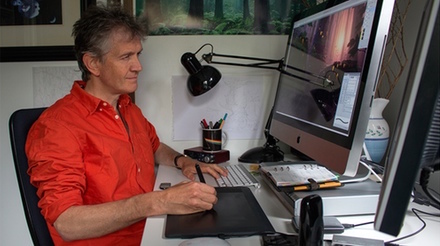
John working on the cover for ‘Journeys to Somewhere Else’
What does your artistic process involve; the stages of developing from your imagined ideas into a finished artwork?
It’s become pretty rigid these days.
I always booked months ahead, so I’m often thinking up solutions to the next jobs, making notes or taking photos if the opportunity arises
The client brief comes mostly in the form of an “artists commission” and after making sure I understand, I write down notes and give written clues to how I will untangle what is needed.
Next it’s reference / inspiration. I will either draw simple designs OR google the subject online OR look at my photo’s (this might lead to a photo shoot, if I need a specific model- figure or environment in doors of out. My style is all about the light source, so I can make this up BUT if I can set up a shoot and get my lighting right, I’m 30% of the way there at the beginning. Good lighting = atmosphere = mood = emotion = involvement.
Then its drawn the old way with pencil (I always always do a line drawing and rarely work ontop of photo’s) I love photography, but it is a tool for my thinking and I use it to work solutions for my ideas. The drawing is then scanned and I will do extensive notes ‘on’ the drawing. It’s then zoomed off to the client. Who will respond within 24 hours or sometimes 7 days if they are annoyingly slow (but I will the following day be getting on with the next job anyway OR taking the day off)
After the drawing is approved (or I do changes) I develop all the tones in photoshop and ‘layer’ the image. Tone come’s first so I can see the image in terms of tonality. No lighting, just the shapes and depth. Then I begin to add colour / detail / form and add lighting once I’m happy with all the tonal masses.
I’m a highly insecure artist and use methodical steps to give myself a handrail of confidence. Often I’m painting fantasy, places that do not exist in reality and I’m making things up, inventing and working the problems out as I do them. As artists we have to be able to paint anything from a figure to a monster, from a cathedral to a tomb stone, from a lolly pop to a banjo
What was your defining moment of breaking into the industry?
It was when a leading publisher, Sphere books in the 1980’s asked me to illustrate a Stephen King book (The Dark Tower V2) I had been working with them for a few years, gained their trust and suddenly seemed to be on the ‘A’ list for the really prestigious jobs. I was excited and terrified. I had recently read Stephen King books and was aware of the privilege and exposure. I went onto Arthur C. Clarke, Peter James, Harry Harrison and Terry Pratchett. Success breeds success!
What makes a fantasy artists’ work stand out?
Their ability to realize fantastical ideas and make them believable. To transport the viewer into a world that might exist and convince them for just one moment that it does. Making a dream a reality, even though it is of course just a dream. We all need to escape, some do it by sport, some by travel, some by taking, some by art / music / writing and film.

Ryuguu Castle
How did you perfect your artistic skills to create your fantasy masterpieces, and are there any resources that particularly helped you to master techniques?
I am largely self taught. Though I went to art college, my style has never been fashionable so it was simply me painting, virtually non stop from a very young age, making many mistakes, keeping going and gradually finding my skills by sheer hard work. I would never regard myself as a master, as so unsure of my self, but what I do have in bucket loads is determination and perseverance. I have never given up on even the most tough works, driven primarily through fear of failure, but always an inner knowing that I can do it.
My skills have just developed from crayons, to water colour / oil paint / acrylics and it was the airbrush that really kicked my skills into a new gear. The instrument was a challenge to master, but it opened many doors with blending and laying down skies etc, enabling me to to move from oil paint to acrylics and actually be able to send off a dry painting the same day I finished one.
However it was digital art that saved me. Nearly 20 years ago I was all but dried up. The alterations and perfectionism were driving me nuts. The usage of Photoshop enabled me to make mistakes and re-do the parts, with the benefit of hindsight. Something I daily feel gratitude towards, especially when I’m feeling unwell.
How did you learn to paint digitally? This must have taken a while!
When I got my first- very very slow computer, I had lessons from a friend but within 5 months just had to charge straight back into work as needed the money. My 2nd computer arrived the very day of my first main digital artwork. A half page advert for the Sunday Times. It was all very stressful as the art needed to go to press that afternoon!- so I had a tech chap sitting next to me and he showed me a few important tools and the job was done my 5pm that day. I was shaking like a leaf but did it.
I have had many Apple Mac’s and use them like glorious tools. They are amazing but you still have to be an artist. My style is based on my painting skills and my marks are literally like my old brush work. Things still are challenging, but we live in privileged times with all these incredible machines at our finger tips.
What do you do to take a break? Any hobbies?
I am a musician and have played guitar since a kid. I used to play in rock bands, but now record all my own music and use Logic Pro on an iMac. I play the keyboard and writing a concept album linking all my art and storytelling. I love music and feel lucky my parents encouraged this side of myself. My wife is a cello player and both sons play in bands, so there are instruments everywhere here!
Any funny/memorable stories concerning previous clients/projects?
Many, especially in the old days when I used to paint 3 figurative book covers a month. All involving quick reference shoots to get my pose and lighting right. The number of times I’ve been in friends’ back gardens with them dressed up as Vampires, Angels, Cowboys, Criminals with guns or wooly monsters if fluffy costumes- as usually on a rainy Monday morning, I’ve been spotted by neighbours who probably think I’m insane and sometimes trying to explain, it just gets worse as such an odd thing to do anyway. I remember my wife holding a red phone poking up through cardboard and her neighbour looking over the wall asking me about when the rubbish is collected, looking on with extreme concern…
Are there any skills you wish you had that are not art related? Why?
Yes. To have been taught at art college more about business management and how to do deals with clients. Us artists are all emotional and some key financial advice would have been great. I did not even know what an invoice was when I started work.
If you had the opportunity, which world/scene in an artwork that you have created would you most like to live in/be a part of and why?
I would love to visit the ‘magic the gathering’ expansion, “Ravnica” where everything is buildings, even the islands and mountains. Architecture is a passion and though hard to paint, it’s a passion of mine

Return To Ravnica – Forest
Are you currently working on anything? Can you give a sneak peak/insight?
I would love too, but we sign NDA agreements and can’t show anything till it is released. My output has slowed down, but I’m still endlessly working and many new images will pop up on my facebook page JohnAvonArt. But usually stuff is about 6 – 9 months in production and client confidentiality is critical.
Illustration is not an easy way to make a living. It’s about as tough as being a writer, actor or musician. But the rewards are huge and if your prepared to work hard a glorious profession. You get out what you put in and perseverance is key.
View more of John’s work at:
 Blog
Blog 